


One of the biggest benefits of hosting an Au Pair is flexible childcare. Instead of trying to fit your family’s needs into a daycare’s hours or a babysitter’s availability, you can create a childcare schedule around your family’s actual routine.
But what does that flexibility look like in practice?
For families considering an Au Pair, it’s helpful to see what a real Au Pair schedule looks like. How do 45 hours fit into a week? What happens when parents work different shifts? Can an Au Pair help with school drop-off and afternoon activities? And how does the schedule still allow plenty of off-duty time and time for cultural exchange?
Under the U.S. Department of State’s Au Pair Program, an Au Pair can provide up to 10 hours of childcare per day and 45 hours per week. Host families must also provide at least 1.5 days off each week, along with one full weekend off each month.
The exact schedule and full list of Au Pair duties will look different from family to family. Here are four real Au Pair schedules from real Host Families to show how those limits can work for different lifestyles.
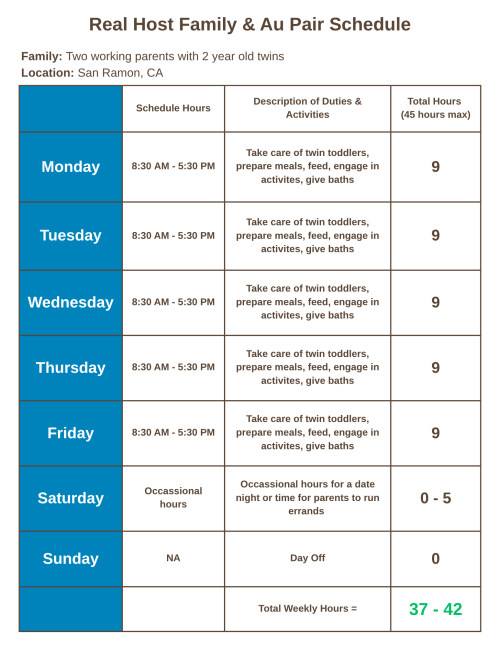
Dual Career Family with Toddlers
For dual-career families with young children, an Au Pair can provide coverage during the busiest parts of the day without requiring parents to rush through morning routines or race home for daycare pickup.
In the schedule below, from a real Host Family located in San Ramon, CA, you can see the Au Pair daily routine gives the parents consistent weekday coverage while giving the Au Pair evenings and most weekends free.
The family could also adjust the hours on different days as long as the schedule stays within the daily and weekly limits.
Split Shift Healthcare Workers
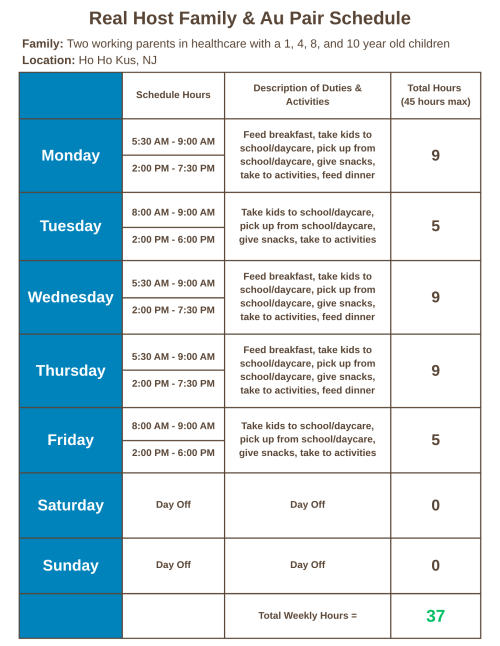
Traditional 9 to 5 childcare can be particularly challenging for parents who work in healthcare. One parents might start work in the early morning while another doesn’t get home until the evening. And sometimes those schedules change day by day. An Au Pair split shift can help bridge those gaps.
The example below from a real Host Family with both parents working in healthcare located in Ho Ho Kus, New Jersey shows how the Au Pair’s childcare schedule is split each day. The Au Pair in this family can spend 4 hours taking classes, experiencing local culture, or however they choose.
This schedule also leaves flexibility for unexpected situations, like a surgery running a bit late or traffic coming home. Flexibility doesn’t mean unlimited hours, it means some wiggle room when needed while staying within program requirements.
"It is next to impossible to find anyone willing to take a split shift of 2-3 hours in the morning plus 5-6 hours in the evening with a 6 hours break in between. The split shift is a great benefit for Au Pairs as that gives a convenient midday timeslot for them to take classes."
Host Dad - Nayden
School Age Kids With Activities
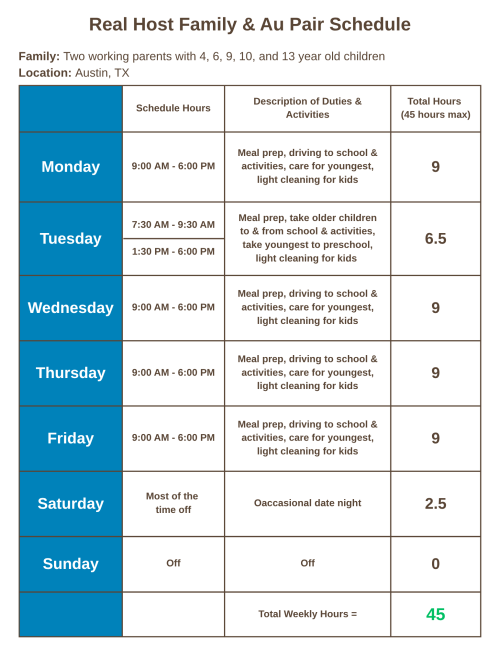
With two working parents who have multiple school aged children, an Au Pair gives flexible childcare during busy school days. Parents can count on their Au Pair to cover school drop offs, prep meals, and even provide some weekend care where needed.
You can see in the schedule below from a real Host Family located in Austin, TX they have 4 school aged children and a toddler in pre-school once a week. This Au Pair daily routine gives the parents consistent weekday coverage and the kids are getting to where they need to be each day with some meal prep and cleaning up after the children.
In the below schedule you can see the Au Pair will have evenings and most weekends off with a split shift each week giving them free time to fulfill their Au Pair program goals.
Working parents with school aged kids can see why Au Pair scheduling beats daycare hours and how the Au Pair’s work schedule remains flexible.
Single Parent With an Infant
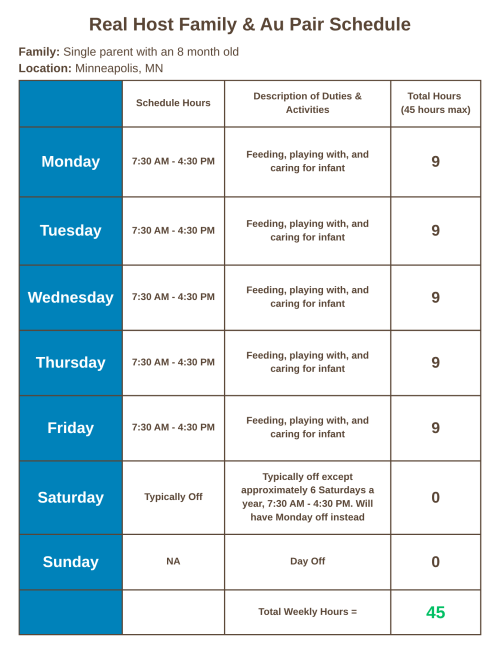
For a single parent, reliable childcare can be especially important because there isn’t another parent available to cover unexpected gaps between work and childcare.
In the example below from a real single parent Host Family in Minneapolis, MN you can see the Au Pair provides daily childcare with the majority of full weekends off. In this situation the parent has listed approximately 6 Saturdays where the Au Pair will need to provide childcare and states in this situation the Au Pair will have Monday off instead.
By informing the Au Pair at the beginning of the placement that there will be occasional schedule changes the Au Pair knows flexibility will be required while staying withing the 45 hours per week program regulations. The Au Pair can also plan their free time around a schedule like this because they are aware of changes in advance.
"As a single mom by choice who works in healthcare, finding childcare that matches my sometime irregular hours can be hard to find. The first Au Pair joined our family when my daughter was an infant, and in the final year before she starts kindergarten we're still going Au Pair strong! The flexibility to creatively arrange my Au Pair's weekly work schedule to accommodate my on-call weekends, to take care of the occasional dinner when I have a staff meeting, and to have someone to travel with us when I present at a conference has been invaluable. "
Host Dad - Jaime
What These Real Life Au Pair Weekly Schedules Show
There isn’t one “perfect” Au Pair schedule. That’s really the whole point.
A family’s childcare needs might look like:
- Traditional: 9 hours a day, five days a week
- School-focused: Before-school and after-school coverage
- Split shift: Morning and evening coverage around a parent’s workday
- Activity-heavy: Afternoon transportation, homework, dinner, and activities
- Mixed: Different hours on different days based on parents’ work schedules
The common thread is that the schedule needs to stay within the program’s limits: no more than 10 hours of childcare in a day and no more than 45 hours per week, while providing the required time off.
Don't Forget Off Duty Time
One of the most important parts of creating a successful schedule is being clear about when the Au Pair is off duty.
If an Au Pair works from 7:00–9:00 a.m. and then again from 3:00–7:00 p.m., the hours in between are not automatically available for childcare. That is the Au Pair’s personal time.
Clear boundaries help everyone know what to expect and make it easier for an Au Pair to enjoy their time in the United States while becoming part of the Host Family and sharing each other’s culture.
Host Families are also required to provide at least 1.5 consecutive days off each week, one complete weekend off each month, and two weeks of paid vacation for each 12-month exchange term.
The Best Au Pair Schedule Is the One That Fits Your Family
When families hear “flexible childcare,” it can be difficult to picture what that actually means. The answer is different for every family.
Before matching with an Au Pair, think about your family’s actual week and download our Host Family and Au Pair Schedule to try it out for yourself.
Look at when parents leave for work, when children wake up, school and activity schedules, commuting time, dinner routines, and when everyone needs downtime. Then build your childcare schedule around those needs while staying within the program’s hour and time-off requirements.
That’s where the flexibility of an Au Pair becomes tangible. Childcare can be structured around your family’s life instead of your family having to structure everything around childcare. If this sounds like you, it’s time to find an Au Pair that fits your schedule.